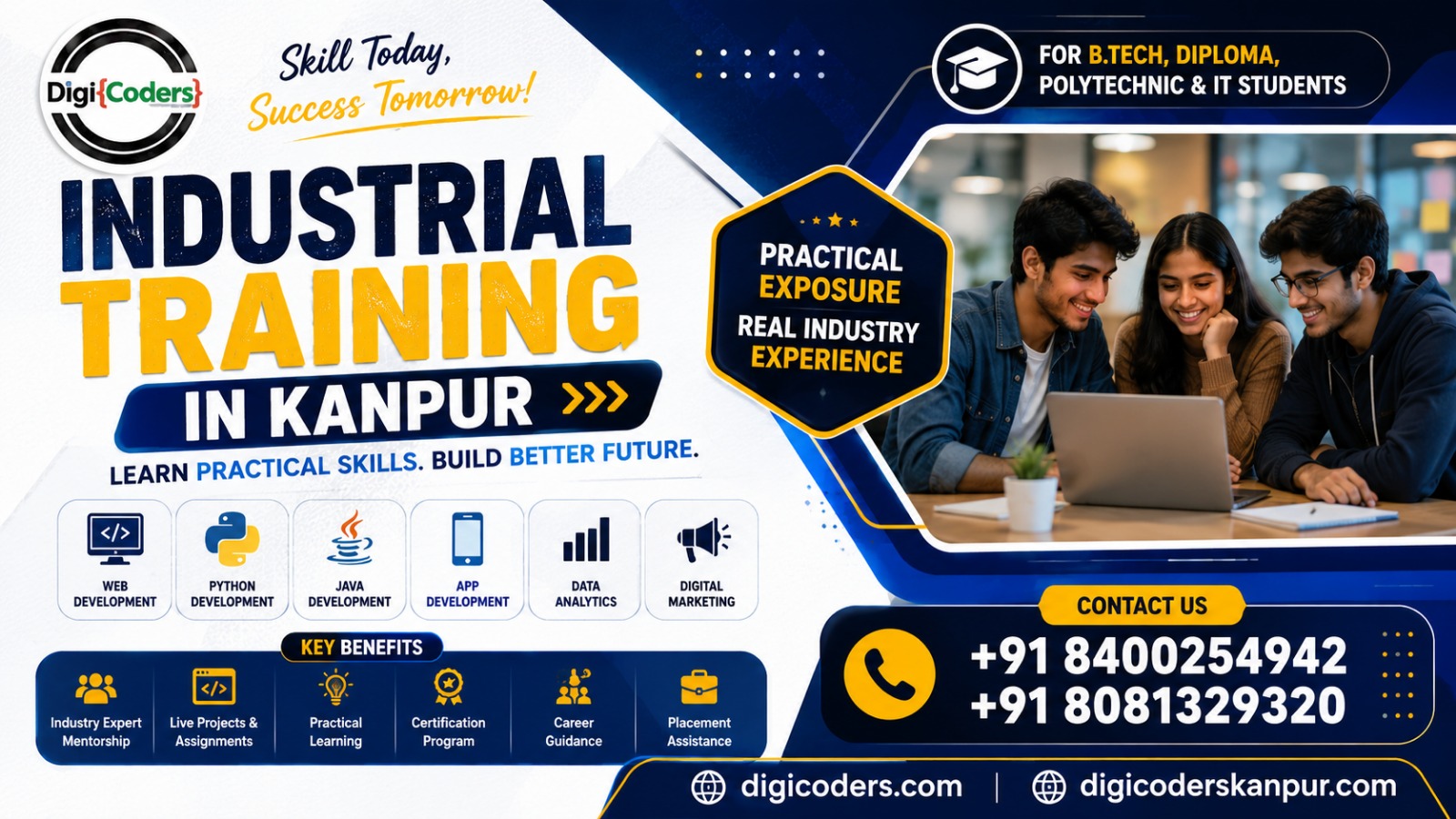
For technical students, completing a degree or diploma is only the beginning of a professional journey. Classroom education helps students understand important concepts, but practical experience teaches them how those concepts are used to solve real problems.
An Industrial Training in kanpur can help students gain this practical exposure. During training, students can work with industry-related tools, practise technical skills, complete projects, interact with mentors, and understand professional work methods.
Kanpur also has established technical and skill-development institutions. For example, the National Skill Training Institute (NSTI) , digicoders Kanpur operates under the Ministry of Skill Development and Entrepreneurship and provides vocational and industry-oriented training. National Skill Training Institute
If you are a B.Tech, Diploma,
Polytechnic, BCA, MCA, or another technical student, this guide will help you
understand the eligibility, duration, fees, learning areas, benefits, and
important points to consider before joining industrial training in Kanpur.
What Is Industrial Training?
Industrial training is a practical
learning experience designed to help students understand how technical
knowledge is applied outside the classroom.
In college, students may learn
programming languages, databases, networking, electronics, software
engineering, or other subjects through lectures and assignments. Industrial
training gives them an opportunity to practise those concepts through practical
activities.
For example, a student who has studied web development may learn how to create a complete website. A student interested in data may work with datasets and dashboards, while a programming student may develop an application
The exact training structure depends
on the institute, technology, and program.
Why Is Industrial Training Important?
There is often a difference between knowing
a concept and being able to use it.
A student may understand the theory
of programming but still find it difficult to develop a complete application
independently. Practical training provides an environment where students can
learn by doing.
During training, students can learn
to:
- Apply classroom concepts
- Use professional development tools
- Work on technical assignments
- Develop projects
- Find and fix errors
- Work according to deadlines
- Communicate with mentors
- Understand project requirements
- Present their work
This experience can make students
more comfortable when they start applying for internships, jobs, or further
training.
Who Is Eligible for Industrial Training in Kanpur?
There is no single eligibility rule
for every industrial training program. Requirements depend on the organization
and the selected course.
Generally, industrial training
opportunities may be suitable for the following students.
B.Tech Students
B.Tech students from Computer
Science, Information Technology, Electronics, Electrical, Mechanical, and other
technical branches can look for programs related to their specialization.
Students should select training
according to their career interests rather than simply choosing a popular
technology.
Diploma Students
Diploma students can also benefit
from practical training. Their program should ideally be connected with their
technical branch and future career plans.
Polytechnic Students
Polytechnic students can use
industrial training to understand how the concepts taught in their curriculum
are applied in professional environments.
BCA and MCA Students
Students from computer application
backgrounds can explore training in software development, web development,
programming, databases, data analytics, and related IT areas.
Final-Year Students
Final-year students often use
industrial training to strengthen their practical profile before entering the
job market.
Some government skill-training
programs also explicitly allow candidates from ITI, Diploma, engineering, and
related backgrounds. For example, NSTI Kanpur's short-term AVTS information
states that ITI, Diploma, and Engineering candidates with relevant experience
may apply for listed courses. (National Skill Training Institute)
Always check the eligibility
criteria of the specific training program before registration.
Duration of Industrial Training in Kanpur
The duration of industrial training
is not fixed for every institute.
Depending on the course and purpose,
training may be offered for:
- A few weeks
- 1 month
- 2 months
- 3 months
- 6 months
- Longer periods for specific programs
Some courses are designed as
short-term skill programs, while others provide longer and more detailed
training.
For example, current NIELIT course
listings show programs ranging from a few weeks to several months, including
Full Stack Development courses and other technology-focused programs. (NIELIT)
📞 91+6394296293
🌐 digicoderskanpur.com
Which
Duration Is Better?
The answer depends on your goal.
If you only want to understand the
basics of a technology, a short program may be sufficient.
If you want deeper practical
experience and more project work, a longer program can be more useful.
However, duration alone does not
decide the quality of training. Curriculum, practical work, mentorship,
projects, and learning support are equally important.
Industrial Training Fees in Kanpur
There is no single fee for
industrial training in Kanpur.
The amount can depend on:
- Training duration
- Selected technology
- Number of practical sessions
- Project work
- Trainer support
- Lab facilities
- Certification
- Learning resources
- Institution or training provider
Government and private training
programs can have very different fee structures.
For example, NSTI Kanpur currently
publishes separate fee structures for its CTS and CITS programs. Its CTS fee
information lists a general-category total of ₹2,400 and an SC/ST category
total of ₹900 for the specified components, while hostel charges are separate.
(National Skill Training Institute)
Similarly, NIELIT's 2026 course listings show different fees for different technology programs—for example, Full Stack Development and other IT courses have their own course-specific fees.
Therefore, students should never
assume that one fee applies to every industrial training program.
Before admission, ask for the
complete fee structure and confirm what is included.
📞 91+6394296293
🌐 digicoderskanpur.com
What
Can Students Learn During Industrial Training?
The learning depends on the selected
field. Students should choose a technology that supports their future career
plans.
Web Development
Web development training can
introduce students to:
- HTML
- CSS
- JavaScript
- Responsive design
- Bootstrap
- Front-end development
- Back-end development
- Databases
Students can gradually move from
basic webpages to complete website projects.
Python Development
Python training may cover:
- Python fundamentals
- Functions
- Object-oriented programming
- File handling
- Database connectivity
- APIs
- Automation
- Application development
Java Development
Students can learn Java programming,
object-oriented concepts, database connectivity, application development, and
related technologies.
App Development
Students interested in mobile
applications can learn application design, development, databases, APIs,
testing, and other mobile-development concepts.
Full-Stack Development
full stack training helps students
understand both the front end and back end of a web application.
It can be useful for students who
want to understand how a complete web product is developed.
Data Analytics
Data-focused training may include:
- Excel or spreadsheet tools
- SQL
- Data cleaning
- Data visualization
- Dashboards
- Basic data analysis
Digital Marketing
Students interested in online
marketing can explore:
- SEO
- Keyword research
- Content planning
- Social media marketing
- Website analysis
- Analytics
- Online campaign planning
The important thing is to select a
field where you can see yourself building a career.
Benefits of Industrial Training
Industrial training can provide
several advantages when the program includes genuine practical learning.
1. Practical Knowledge
Students can use the concepts they
have studied instead of limiting their learning to theory.
2. Project Experience
Projects help students understand
how individual concepts work together to create a complete solution.
3. Technical Confidence
Regular practice can make students
more comfortable using programming languages, software, databases, and other
tools.
4. Problem-Solving Skills
Technical work often involves errors
and unexpected situations. Learning to identify and solve these problems is
valuable for future jobs.
5. Professional Exposure
Students can become familiar with
deadlines, teamwork, communication, task assignment, and project discussions.
6. Better Resume
A genuine training experience with
meaningful projects can strengthen a fresher's resume.
7. Interview Preparation
Students can use their project
experience to answer questions about technologies, responsibilities,
challenges, and solutions.
8. Career Direction
Practical experience can help
students decide whether they actually want to pursue a particular technology.
9. Portfolio Building
Students can showcase suitable
projects in their portfolio, provided the work is genuinely theirs.
10. Transition From College to Career
Industrial training can help
students become more familiar with professional expectations before they begin
their full-time career.
What Projects Can Students Work On?
Project work should be an important
part of technical training.
Depending on the selected field,
students may develop:
- Business websites
- E-commerce websites
- Portfolio websites
- Student management systems
- Online quiz systems
- Attendance applications
- Mobile applications
- Data dashboards
- Database-based applications
- Digital marketing campaigns
A project becomes more valuable when
students understand the complete development process.
Instead of simply copying code from
the internet, students should understand why the code works, how the project
is structured, and how problems were solved.
📞 91+6394296293
🌐 digicoderskanpur.com
How to Choose the Best Industrial Training in Kanpur?
Students should compare training
programs carefully before making a decision.
Check the Curriculum
The course should cover technologies
that match your career goal.
Look
for Practical Sessions
Ask how much of the training
involves hands-on activities.
Understand
the Project Work
Find out whether students actually
develop projects or only receive theoretical assignments.
Check
Mentor Support
Good guidance can make it easier to
understand difficult concepts and solve technical problems.
Ask
About Certification
Understand the requirements for
receiving the certificate and what the certificate represents.
Check
Training Schedule
Confirm the duration, working hours,
attendance requirements, and batch timings.
Compare the Fees
Do not select a course only because
it is cheap. Compare the learning facilities and practical exposure included in
the fee.
Ask About Career Support
If the institute offers interview
preparation, career guidance, or placement assistance, understand exactly what
support is provided.
Industrial Training vs Classroom Learning
Classroom learning and industrial
training have different purposes.
Classroom learning mainly helps students build academic and theoretical
knowledge.
Industrial training gives students opportunities to apply that knowledge in
practical situations.
For example, a student may study SQL
in college. During training, that student might create a database, write
queries, connect it to an application, and troubleshoot database errors.
Both forms of learning are
important. Strong academic fundamentals combined with practical experience can
give students a better foundation for professional work.
Is Industrial Training Useful for Freshers?
Yes, practical training can be
especially useful for freshers.
When students apply for their first
job, they may have limited professional experience. Projects and training can
give them real examples to discuss during interviews.
For example, instead of simply
saying:
I know Java.
A student can explain:
I used Java during my summer training to develop a project, connected the application with a database, faced several errors, and worked on fixing them.
This type of explanation
demonstrates practical understanding.
However, training does not
automatically guarantee employment. Students still need strong technical
skills, communication, problem-solving ability, and interview preparation.
Common Mistakes Students Should Avoid
Students can reduce the value of
their training if they focus only on completing it.
Avoid these common mistakes:
- Choosing a course without checking the syllabus
- Selecting a technology only because it is popular
- Skipping practical sessions
- Copying projects without understanding them
- Ignoring mentor feedback
- Not practicing outside training hours
- Focusing only on the certificate
- Learning too many technologies at the same time
- Neglecting communication skills
The goal should be to finish
training with knowledge that you can demonstrate independently.
Documents Usually Required
The required documents depend on the
organization. Common requirements may include:
- College ID card
- Resume or CV
- Academic details
- Identity proof
- Recent photographs
- Registration form
- College permission or NOC, where applicable
Students should confirm the exact
requirements before submitting their application.
Career
Opportunities After Industrial Training
Career options depend on your
educational background, skills, selected technology, project experience, and
interview performance.
Students may explore entry-level
positions such as:
- Web Developer
- Front-End Developer
- Back-End Developer
- Python Developer
- Java Developer
- Software Developer
- App Developer
- Data Analyst
- Digital Marketing Executive
- Junior Software Engineer
Industrial training can help build a foundation, but students should continue learning after the program because technology and employer requirements keep changing.
Final
Thoughts
Choosing the right industrial training in Kanpur can help students turn academic knowledge into practical
ability. Whether you are pursuing B.Tech, Diploma, Polytechnic, BCA, MCA, or
another technical course, practical exposure can make your learning more
meaningful.
Before joining any program, compare
its eligibility, duration, fees, curriculum, practical sessions, project
work, mentor support, certification, and career guidance.
Most importantly, do not judge an
internship only by its certificate. A valuable training experience should help
you learn something you can actually use.
Learn the concept. Practise the
skill. Build the project. Understand your work. Prepare for your career.
Contact
Us
Looking for practical Industrial
Training in Kanpur? Connect with DigiCoders for industry-focused learning,
practical projects, and career guidance.
📞 91+6394296293
🌐 digicoderskanpur.com
Visit DigiCoders,Kanpur: Shehnai Chauraha, 340, near Annapoorna Hospital, S Block, Yashoda Nagar, Kanpur, Uttar Pradesh 208011
Note: This article is freshly written rather than copied from a
source, but no writer or AI system can honestly guarantee a specific
plagiarism-checker score such as “100% unique.” Different plagiarism tools use
different databases and matching algorithms. The content has been written with
original wording and natural keyword placement rather than keyword stuffing.