Introduction
Summer vacation can be much more than a break from college. For engineering students, it can be an excellent opportunity to learn a practical technology, work on projects, improve programming skills, and prepare for future career opportunities.
Among different programming technologies, Java remains an important language for students who want to understand software development, backend programming, enterprise applications, APIs, and application development. Its structured programming approach also helps students build a strong understanding of object-oriented programming.
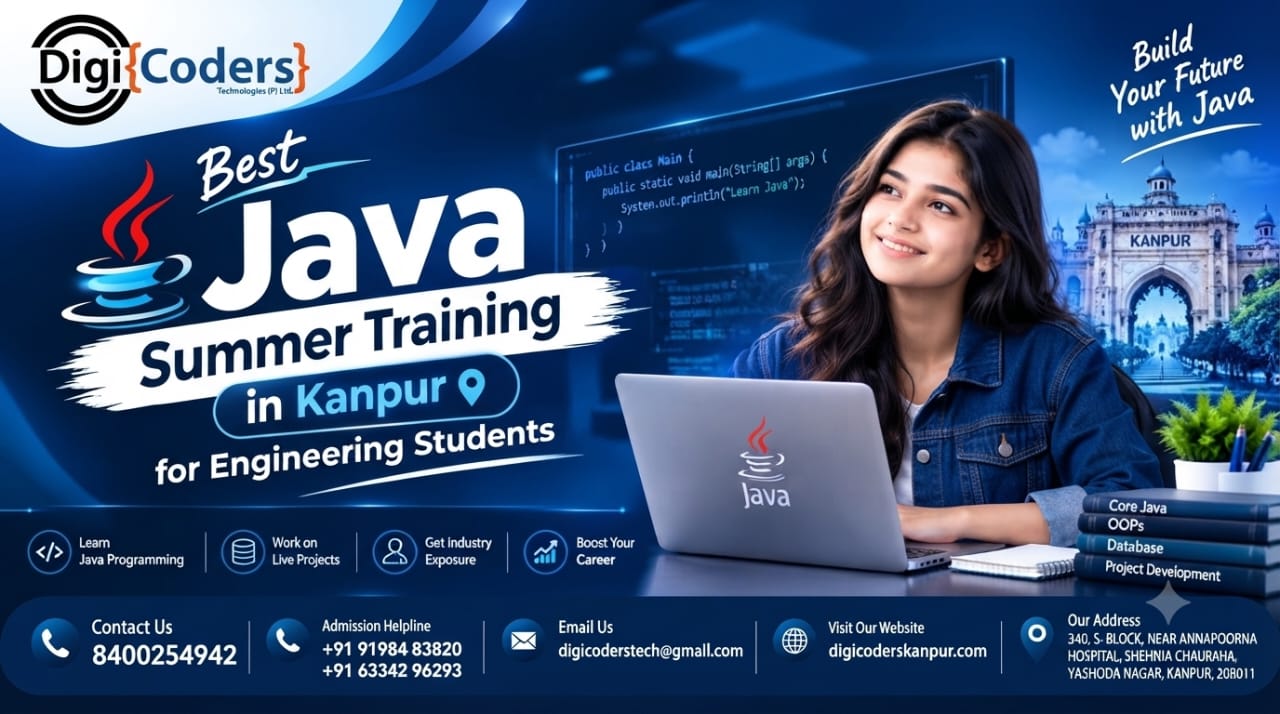
For students looking for Java Summer Training in kanpur , practical training can provide an environment where they can move beyond textbooks and classroom theory. Instead of simply learning syntax, students can practice writing programs, solving coding problems, working with databases, handling errors, and developing projects.
Why Should Engineering Students Learn Java?
Engineering students are often introduced to programming during their academic studies. However, knowing theoretical concepts and being able to develop an application are two different things.
Java training can help students strengthen their understanding of programming through practical exercises.
Students can learn concepts such as:
Variables and data types
Conditional statements
Loops
Methods
Classes and objects
Inheritance
Polymorphism
Encapsulation
Exception handling
Collections
Database connectivity
Multithreading
Application development
These concepts are useful not only for Java but also for understanding broader software-development principles.
What Is Java Summer Training?
Java summer training is a short-term practical learning program generally designed for students during their academic vacation.
The purpose is to provide students with additional technical exposure and give them an opportunity to practice programming in a structured environment.
A well-designed program can take students through a progression such as:
Java Basics → Core Java → OOP → Advanced Concepts → Database Connectivity → Project Development
Instead of completing only theoretical assignments, students can work on applications and understand how different programming concepts are connected.
Why Choose Java Summer Training in Kanpur?
Kanpur is home to a large number of engineering and technical students. Students from B.Tech, BCA, MCA, diploma and other computer-related programs often look for additional training opportunities to improve their technical skills.
One advantage of summer training is that students can dedicate a specific period to learning without having to balance the training with a heavy academic schedule.
The right training program can help students:
Practice coding regularly
Understand Java concepts
Work on practical projects
Improve logical thinking
Learn debugging techniques
Understand database integration
Prepare a project portfolio
Gain confidence for technical interviews
However, students should not choose a course simply because it is called “summer-training” The curriculum, practical sessions, trainer support and project work should also be considered.
Admission Helpline: +91 91984 83820 | +91 63942 96293
Website: digicoderskanpur.com
What Will Students Learn in Java Training?
1. Java Programming Fundamentals
The first stage generally focuses on developing a strong programming foundation.
Students can learn:
Variables
Data types
Operators
Input and output
Conditions
Loops
Arrays
Methods
Basic problem-solving
These topics help students understand how Java programs are structured and executed.
A student who understands the basics properly will find it easier to progress toward advanced programming concepts.
2. Object-Oriented Programming
Object-oriented programming is a major part of Java.
Students learn how to organize programs using classes and objects.
Important concepts include:
Classes and Objects
Students learn how to create classes and use objects to represent data and functionality.
Inheritance
Inheritance allows a class to derive characteristics and behaviour from another class.
Polymorphism
Polymorphism allows programming structures to behave differently depending on the implementation or context.
Encapsulation
Encapsulation helps organize data and methods within a class and control how information is accessed.
Understanding these concepts is important for writing organized and reusable software.
3. Exception Handling
Errors can occur while a program is running. Java provides mechanisms that allow developers to handle many such situations more effectively.
Students can learn concepts such as:
try
catch
finally
throw
throws
Custom exceptions
Learning error handling also teaches students to think about unexpected situations while developing applications.
4. Collections in Java
Applications frequently need to store and process groups of objects.
The Java Collections Framework provides different structures for managing data.
Students may work with:
ArrayList
LinkedList
HashSet
HashMap
List
Set
Map
Practical exercises can help students understand when different collection types are useful.
5. Database Connectivity
Modern applications usually need some method of storing and retrieving information.
Java training can introduce students to database connectivity and CRUD operations.
For example, while creating a student management application, students may implement:
Create → Read → Update → Delete
They can learn how an application communicates with a database and how information is retrieved or modified.
This type of practical knowledge can be useful when students move toward backend or full-stack development.
6. Multithreading
Multithreading introduces students to the concept of performing multiple tasks within an application.
Students can learn basic concepts such as:
Threads
Runnable
Thread lifecycle
Synchronization
Basic concurrency
This topic gives students an introduction to how applications can manage different operations.
Practical Projects During Java Training
One of the most valuable aspects of technical training is project development
Instead of learning concepts independently, students can combine different topics while creating an actual application.
Possible Java project ideas include:
Student Management System
An application for storing and managing student information.
Library Management System
A system for maintaining books, members and issue-return records.
Employee Management System
An application for managing employee information and records.
Online Quiz Application
A program that allows users to answer questions and calculate scores.
Inventory Management System
A system for tracking products, quantities and inventory records.
Billing Application
A project that can demonstrate product selection, calculations and bill generation.
Working on such projects allows students to understand how programming concepts work together.
Benefits of Java Summer Training for B.Tech Students
Improve Programming Logic
Regular coding exercises can help students develop better problem-solving habits.
Gain Practical Exposure
Students can apply theoretical concepts to practical applications.
Build a Portfolio
Completed projects can be showcased in a resume or portfolio when applying for internships and entry-level positions.
Understand Software Development
Training can introduce students to the development process rather than focusing only on individual programming topics.
Prepare for Interviews
Students can become more comfortable discussing Java, OOP, databases, and their projects during technical interviews.
Develop Confidence
Regular practice can make students more comfortable with writing and debugging code.
Who Can Join Java Summer Training?
A practical Java program can be considered by:
B.Tech CSE students
B.Tech IT students
BCA students
MCA students
Diploma students
Computer Science students
Information Technology students
Engineering graduates
Beginners interested in programming
Students who are completely new to Java can start with basic programming concepts before moving toward Core Java and project development.
How to Select the Best Java Training Institute in Kanpur?
Choosing a training institute requires more than comparing fees.
Check the Curriculum
Look for a curriculum that covers programming fundamentals as well as practical development.
Look for Hands-on Practice
Students should get enough opportunities to write code themselves.
Ask About Projects
Project-based learning is valuable because it allows students to apply concepts.
Check Trainer Guidance
A trainer should be able to explain difficult concepts and help students troubleshoot coding problems.
Consider Career Support
Resume guidance, mock interviews, technical preparation and career counselling can be useful additions.
Check Training Environment
A proper computer lab and development environment can make practical learning easier.
Career Scope After Learning Java
Java knowledge can provide a foundation for several SoftwareDevelopment career paths.
Depending on additional skills and experience, students can explore positions such as:
Java Developer
Junior Java Developer
Backend Developer
Software Engineer
Application Developer
Web Application Developer
Students can further strengthen their profile by learning technologies such as databases, REST APIs, Spring/Spring Boot, Git, cloud platforms and testing tools.
It is important to remember that completing a training course alone does not guarantee employment. Career growth depends on practical skills, projects, problem-solving ability, communication, interview performance and continuous learning.
Java Training + Project Development = Better Practical Learning
Consider a student who has learned classes, objects, inheritance and database connectivity separately.
The student may understand every definition but still struggle to create a complete application.
A project brings these concepts together.
For example, while developing an Employee Management System, the student may need to:
Design classes
Create objects
Store employee information
Connect the application with a database
Add new records
Search information
Update records
Delete records
Handle errors
Test the application
This type of practice gives students a better understanding of how software is actually developed.
Why Summer Is a Good Time to Learn Java
Engineering students often have limited time during regular semesters because of assignments, examinations and other academic responsibilities.
Summer provides an opportunity to focus on one technology for a dedicated period.
Students can use this time to:
Learn → Practice → Build → Test → Improve
The objective should not be simply to finish a certificate. The real goal should be to develop a skill that can continue to be used after the training ends.
Java Summer Training in Kanpur for Engineering Students
For engineering students, choosing a practical Java Summer Training in Kanpur can be a useful step toward strengthening programming knowledge.
DigiCoders Kanpur provides technical training opportunities for students interested in programming and software development.
DigiCoders Kanpur
📍 Address : 340, S-BLOCK, NEAR ANNAPOORNA HOSPITAL, SHEHNAI CHAURAHA, YASHODA NAGAR, KANPUR, 208011
Admission Helpline: +91 91984 83820 | +91 63942 96293
Website: digicoderskanpur.com
Students can contact the institute to enquire about the current Java training batch, course structure, duration, fees, practical sessions and admission process.
Conclusion
Learning Java during the summer can give engineering students an opportunity to invest their vacation in practical skill development. From programming fundamentals and object-oriented programming to databases and project development, Java training can help students understand important aspects of software development.
The best results come when students combine classroom learning with regular coding practice and project work. Instead of focusing only on completing a course, students should aim to understand concepts, solve problems independently and build applications that demonstrate their abilities.
If you are searching for Java Summer Training in Kanpur, compare the curriculum, practical exposure, projects, trainer support and career guidance before making your decision.
📞 Contact DigiCoders Kanpur
Contact us: +91 91984 83820 | +91 63942 96293
Email: digicoderstech@gmail.com
Address: 340, S-BLOCK, Near Annapoorna Hospital, Shehnai Chauraha, Yashoda Nagar, Kanpur, 208011
Website: digicoderskanpur.com